When I think of Perth, I think of McIver station. A station that appears almost as central as you can get on a map of Perth, nestled beside the busy knot of the Graham Farmer Freeway interchange and one stop away from Perth Station itself. But despite its geography, everything about McIver feels peripheral.
In fact I’d go as far as to say that if McIver is central to anything, it’s central to a zone of the CBD that has peripherality as its defining characteristic. A second CBD, if you like, roughly demarcated by Pier, Wellington, and Lord Streets. In here, the offices of local IT companies back onto methadone clinics and homeless outreach services. Between bland corporate facades and security fencing the streets are mostly unpeopled, yet they radiate a strangely liminal sense of hopelessness and unease.
I have chosen the end of Nash Street, overlooking McIver station, to begin this walk. Here we can see the empty platform behind some shrubs and utility cabinets.

Behind the trees on the other side there’s the looming presence of the Royal Perth Hospital multi-storey carpark, but on the north end we are bounded by non-climbable fencing and the glass-walled offices of the Mental Health Commissioner.

McIver train station itself has a sort of shadowy presence in Perth’s urban lore. As a station best avoided, it has none of the brand-name recognition afforded to Armadale or Midland. Most Perth residents forget it even exists. Yet it’s only when you find yourself here that you are reminded of its grimly transient atmosphere. This is a station at the intersection of myriad services that alternately sentence people, fine people, or fix people before ejecting them back onto the streets. Likely this explains many of the negative experiences that have contributed to McIver station’s 2-star rating.

That said, walking on Google Maps, I can’t help but feel a sense of nostalgia as I leave the station, because the lack of both pedestrians and shade feels like the Perth CBD I know. A city of hot roadways and sunblasted cement rendering, where being at the edge of things is a core part of our identity. In that sense, perhaps the heart of the Perth CBD is not Murray Street Mall but McIver.

In Nash Street’s dull facades we can also see the way that Perth keeps the costs of its isolation hidden. Inside these disposable architectures, beneath fluorescent lights and whirring fans, people navigate byzantine systems in an effort to cope with the afflictions that come with living in the middle of global nowhere. I walk past The Beacon, a homeless shelter whose clean beige exterior looks nice enough. Yet Louisa Martin tells me:

The exterior of the building is pleasant. The interior, however, tells a different story.
How often this applies in Perth! Not just in McIver but in Perth at large, where freshly built Dale Alcock homes are corded off by police investigating domestic tragedies, grandmotherly red brick rentals are gutted by drug lab disasters, and perfectly average offices house air-conditioners that are liable to fail at any moment.
Over on Pier Street a man stands in a tiny sliver of shade beneath the monolithic and windowless box that is the Office of Major Transport.
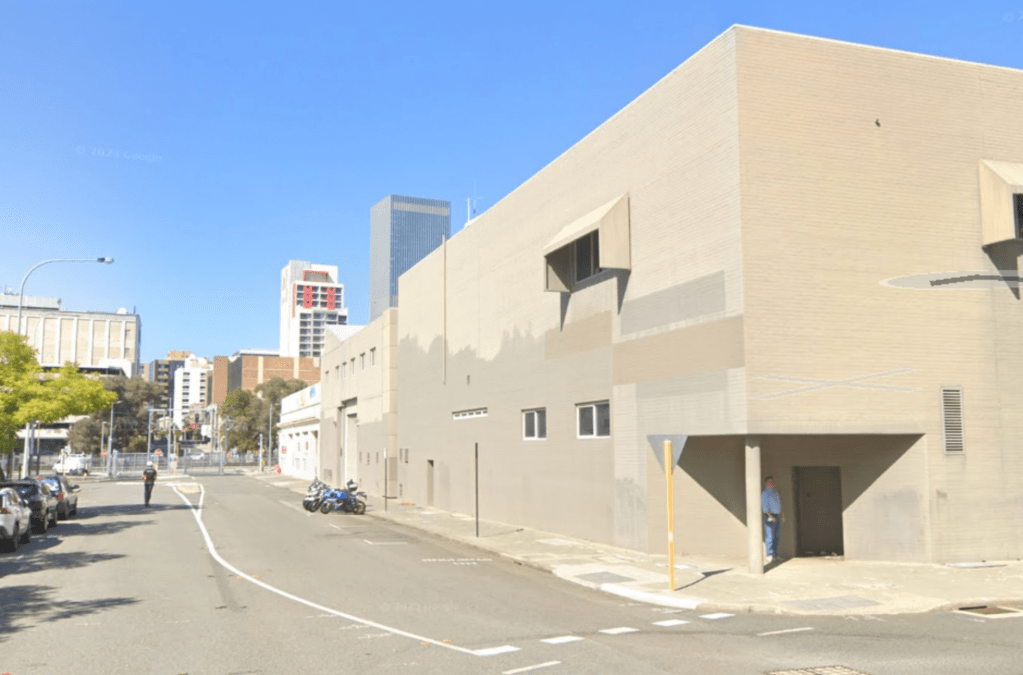
Opposite we can see the Children’s Court, which receives this ringing endorsement from one happy attendee of the public gallery:

In McIver, government institutions designed to punish and rehabilitate are uniformly featureless and indistinguishable to all but the most experienced customers, of which there are many. Looking at the map, it becomes clear that the entire cycle of addiction could play out in a five kilometre radius. On the south side of the tracks you have Royal Perth Hospital, while on the north side you have all manner of clinics, legal services, and short-stay accommodations. And between them you have interstitial spaces like this carpark on Aberdeen Street; small plots of bitumen that reek of hopeless waiting.

A view of McIver from above reveals that many of these interstitial spaces are dead ends. Streets finish abruptly in cul de sacs and empty car parks, or terminate at the railway in deserts of random pedestrian infrastructure like this one just outside RPH.

To me these disadvantaged spaces are, for better or worse, distinctly Perthian. They are not the trash-strewn alleys and tent settlements of larger cities where poverty blends with density, but mundane, sprawling public areas that remain somehow featureless despite the sordid dramas they host.
So when I look at these banal loading bays and empty plazas, I understand that they are also urban cracks for people to fall through. And as I think of these people by the rails at McIver, I know that they are enmeshed in struggles I could never hope to understand from my comfortable vantage behind a screen thousands of kilometres away. Yet all the same, I can still hear their nocturnal mutterings and the screech of the train as it nears McIver station – the first stop on a long journey out into the periphery.
 Jackson's Ephemera
Leave a comment